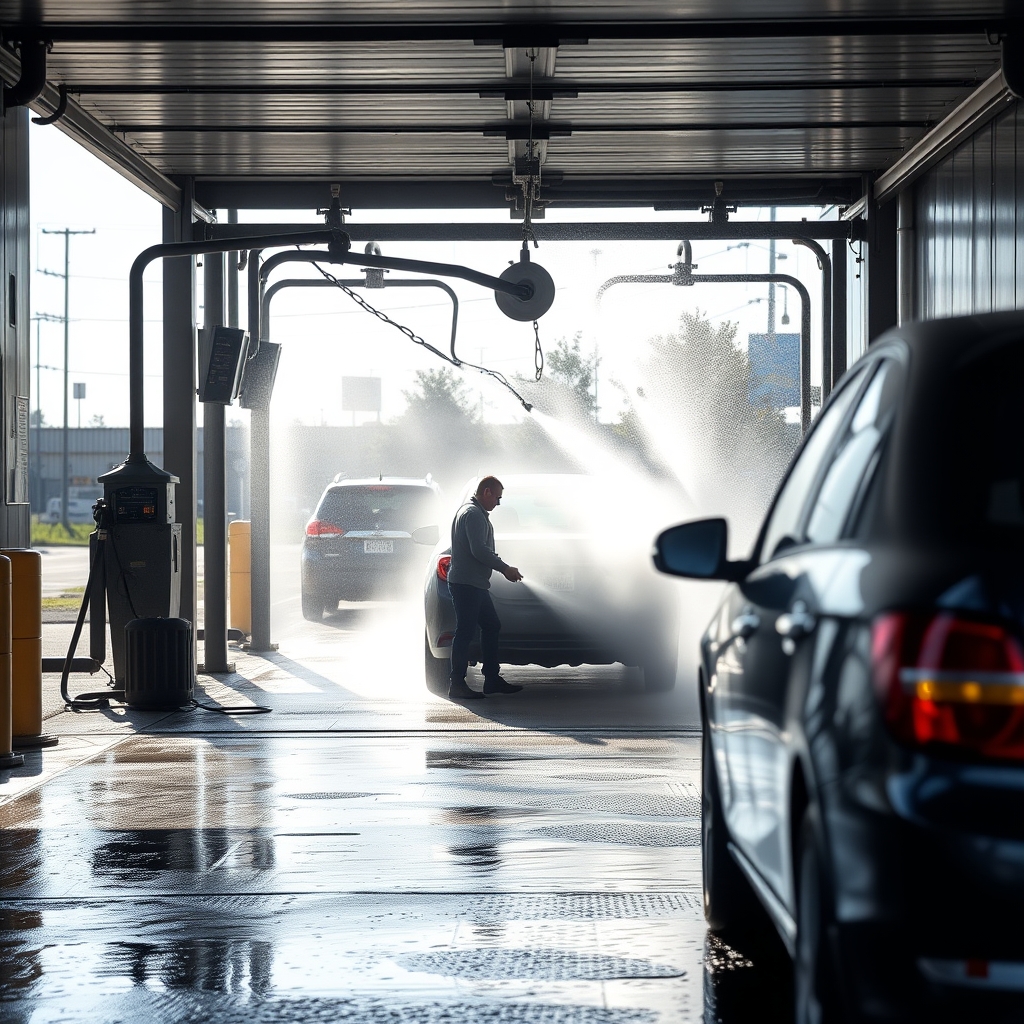
The site and every assumption in this worked example
At this site, focus on member conversion before building a second lane. The estimated retail visits recovered from the queue would not cover the lane’s full annual cost. A conversion effort has a better projected return, although the owner still needs to prove that the new members are incremental.
These numbers describe one illustration, not industry data. Swap in your own counts, prices and costs before deciding.
Assume you own two exterior express locations. The calculation concerns the busier one, where a single pay-station lane backs up. The other location has room but is too far away to assume that a driver who leaves the first site will go there.
For this example, assume:
The busy site has three peak days a week, with two constrained hours per day, for 48 weeks a year. That is 288 peak hours. Outside those hours, it has enough capacity for the extra visits in the membership calculation.
A retail wash sells for $18. Each wash costs $6 in incremental supplies, utilities, wear and transaction-related costs. Memberships sell for $30 a month. Ignore add-ons and sales tax, and assume prices and costs stay unchanged during the comparison.
The current pay-station lane can process 48 cars per hour during the observed peak. The tunnel and exit can handle 60. A second pay-station lane, including the necessary stacking and site work, would let the site handle up to 60 cars per hour without moving the bottleneck downstream. Confirm that assumption before pricing a project.
Measure peak-hour demand the current lanes cannot serve
Stand where you can see the entrance, the pay station and the tunnel. Count cars served, cars that join the queue, and cars that turn away. Note the time, weather and any equipment slowdown. A long line caused by a broken pay station is not, by itself, evidence that you need another lane.
In this illustration, observations and follow-up identify demand for 60 visits in a peak hour. The existing lane serves 48. Of the other 12:
Four drivers return outside the peak and buy their washes anyway. Two are members who skip the visit but keep their memberships. Six are retail drivers who leave without buying or returning.
The lost retail opportunity is therefore six visits per peak hour, not all 12 departures. Assume a second lane would recover four of those six; the other two drivers still choose somewhere else. It also lets the two members wash, but those member visits do not create immediate retail revenue. The site would serve 54 cars in that peak hour, within the assumed tunnel capacity of 60.
Across the year, the estimate is 4 recovered retail visits × 288 peak hours = 1,152 visits. This is a forecast, not a count from a lane that already exists. Check it against repeated observations, and avoid counting the same driver’s return as both a lost and a recovered sale.
Turn the queue estimate into contribution, not gross sales
The extra retail sales would bring in 1,152 × $18, or $20,736. That is not the money available to pay for the lane. The washes themselves have a cost.
At $6 per visit, incremental wash costs are 1,152 × $6 = $7,632. The contribution available toward the lane is therefore $20,736 − $7,632 = $13,104 a year, or $12 per recovered visit.
The member cars matter to the experience at the site. A member who repeatedly sees a backed-up entrance may cancel. For this calculation, however, assume the two members who leave each peak hour would remain members either way. Do not invent a retention benefit to make the project pencil out. If your cancellation records and customer conversations show a measurable queue-related loss, estimate that separately.
Compare the second-lane cost with the member-conversion alternative
Assume the installed second lane costs $90,000, lasts five years for this decision, and has no value at the end. Spread the investment over those years: $90,000 ÷ 5 = $18,000 annually. Add a $4,500 annual capital charge, calculated here as 5% of the original investment, to recognize the money tied up. This is the owner’s chosen hurdle, not a financing quote; do not add loan interest again to the same comparison without adjusting the capital charge.
Assume the lane also adds $2,000 a year in staffing and $1,000 in maintenance. Its full annual comparison cost is $18,000 + $4,500 + $2,000 + $1,000 = $25,500. The $6 per recovered wash was already deducted from contribution, so it is not included again here.
Now compare a membership effort at the same site. Assume it produces 120 incremental member-years: for illustration, 120 retail customers join and remain paid members for a full year who otherwise would not have joined. Exclude people who would have signed up without the effort. Assume each would otherwise buy four retail washes per year, and each member uses 12 washes. The eight additional washes occur outside the constrained peak hours.
Assume the effort costs $9,000 for the year: $6,000 in incremental staff time, $1,000 for signs and materials, and $2,000 in incremental recurring-payment processing and administration. Assume no separate startup investment. These are projections to test, not guaranteed results.
Show the arithmetic: which investment wins at this site?
For the lane, annual contribution of $13,104 minus annual cost of $25,500 gives −$12,396. The additional lane does not clear the owner’s chosen cost hurdle.
For each incremental member-year, membership revenue is $30 × 12 = $360. Subtract the $72 revenue from four retail washes the customer would otherwise have purchased. Subtract $72 for 12 member washes, and add back the $24 cost of the four retail washes no longer sold. Incremental contribution is $360 − $72 − $72 + $24 = $240 per member-year.
At 120 incremental member-years, that is $28,800 in contribution. Subtract the $9,000 program cost, and the projected result is $19,800. On these assumptions, conversion wins.
The distinction between signups and incremental member-years is important. A customer who was going to join anyway does not supply the full $240 benefit. Nor does a customer who stays only part of the year supply a full member-year. Compare results with a period or group where the offer was not actively presented, and adjust for differences such as weather and traffic.
What a two-location independent can compete on—and what it cannot
You do not have to match every express chain’s footprint. You can make the entrance easy to understand, keep the pay station moving and have an attendant explain the club without holding up the line. A familiar local owner can also ask departing drivers what went wrong and fix the answer at that site.
At check-in, CarCare can log retail washes and show member versus retail washes and the capture rate. Use that view alongside your register and traffic counts to see whether the conversion effort changes the mix. It does not establish which signups were incremental; that requires your own comparison.
Do not promise a member a wash on a past-due account while the card is being fixed. Offer a retail wash at your register and direct the customer to the card-update link. For someone considering cancellation, a pause or cheaper plan may fit better than a plan they no longer use.
Convenience and relationships can win customers, but they do not make an underused lane pay for itself. Chains may spread investments across more locations; your bank statement still has to support each site’s decision.
Set a decision threshold and review it before committing
At the assumed $12 contribution per recovered retail visit, the lane needs $25,500 ÷ $12 = 2,125 recovered visits a year to break even. Across 288 peak hours, that is about 7.4 recovered retail visits per hour. The illustration identifies only six lost retail visits per hour before allowing for drivers who still would not return. On those observations, the lane cannot reach the threshold from recovered retail visits alone.
For conversion, the $9,000 cost divided by $240 contribution requires 37.5 incremental member-years to break even on these assumptions. If actual retention, wash use or displaced retail spending differs, recalculate that contribution before judging the result.
Count queues again across representative peak periods, obtain a complete installed quote, and verify tunnel and exit capacity. Then test the conversion effort and review incremental paid member time, wash use and costs. Revisit the lane only if measured recoverable demand or a separately supported retention benefit closes the gap. Until then, put the money where this site can earn it.
Start your wash club on CarCare
If you want the membership side of this running at your wash, this is what setup looks like in CarCare:
- Create your account. Start the 30-day free trial. No credit card needed.
- Add your wash and your membership plans. The setup wizard asks for your business name and address, then the plans you sell: price and washes per month, or unlimited.
- Connect Stripe. Stripe bills your members every month and the payouts go to your bank account.
- Print your signup QR. Each location gets its own signup page and QR code for the pay station and your lane signs.
Start your free 30-day trial or see how it works at the lane.